Wednesday, October 30, 2013

Are First Solar Investors Playing With Fire?

With shares of First Solar (NASDAQ:FSLR) trading at around $55.01, is FSLR an OUTPERFORM, WAIT AND SEE or STAY AWAY? Let's analyze the stock with the relevant sections of our CHEAT SHEET investing framework:

C = Catalyst for the Stock's Movement

First Solar is one of the most interesting stories on the planet. There are many arguments that can be made from the bullish and bearish sides. Prior to getting to positives and negatives, let's see what the analysts think. Most of them seem to be on the fence, but there are more bears than bulls: 2 Buy, 17 Hold, 8 Sell. It should also be noted that there is a 33.4 percent short position on the stock, which indicates that there are many non-believers.

As far as positives go, last quarter's revenue increased year-over-year, margins are solid, cash flow is strong, and increased solar modular sales helped First Solar swing to a profit for the quarter compared to a loss for the same quarter last year. First Solar has now delivered a profit four quarters in a row. In addition to that, operating expenses were down to $107.1 million from $533 million. FY2013 guidance is for revenue between $3.8 billion and $4.0 billion, which would indicate continued growth. First Solar also commented that the second half of the year should be stronger than the first half of the year.

NEW! Discover a new stock idea each week for less than the cost of 1 trade. CLICK HERE for your Weekly Stock Cheat Sheets NOW!

One big negative is that competitors are making cheaper solar panels due to a decline in the price of polysilicon. Another potential negative is that revenue has declined on a sequential basis. First Solar will layoff 150 North American employees in the coming weeks. This is after laying off 2,000 employees last year. Factory expansions have also been canceled. It's evident that First Solar is most focused on the bottom line. This isn't necessarily a negative for shareholders, but it does indicate that growth might not come as easy as many people think.

When it comes to company culture, it's average at First Solar. According to Glassdoor.com, employees have rated their employer a 3.3 of 5, and 52 percent of employees would recommend the company to a friend. An above average 71 percent of employees approve of CEO James A. Hughes.

The chart below compared fundamentals for First Solar, SunPower Corporation (NASDAQ:SPWR), and SolarCity Corp. (SCTY).

FSLR SPWR SCTY
Trailing P/E 11.33 N/A N/A
Forward P/E 16.02 25.64 N/A
Profit Margin 11.37% -12.98% -73.19%
ROE 11.98% -31.00% -32.92%
Operating Cash Flow 844.80M 316.47M 146.12M
Dividend Yield N/A N/A N/A
Short Position 33.40% 29.90% 16.60%

Let's take a look at some more important numbers prior to forming an opinion on this stock.

T = Technicals Are Strong

The industry is on fire right now. Despite First Solar’s impressive run, it has actually underperformed its peers.

1 Month Year-To-Date 1 Year 3 Year
FSLR 41.08% 74.20% 293.5% -51.14%
SPWR 118.1% 293.6% 335.4% 95.75%
SCTY 146.9% 321.5% 11.76% 11.76%

At $55.01, First Solar is trading well above its averages.

50-Day SMA 40.60
200-Day SMA 31.91
NEW! Discover a new stock idea each week for less than the cost of 1 trade. CLICK HERE for your Weekly Stock Cheat Sheets NOW!

E = Equity to Debt Ratio Is Strong

The debt-to-equity ratio is stronger than the industry average of 0.40.

Debt-To-Equity Cash Long-Term Debt
FSLR 0.15 1.01B 562.66M
SPWR 0.80 505.59M 754.22M
SCTY 0.90 127.29M 282.15M

E = Earnings Have Weakened

Earnings have weakened on an annual basis, but revenue has consistently improved on an annual basis.

Fiscal Year 2008 2009 2010 2011 2012
Revenue ($) in millions 1,246 2,066 2,564 2,766 3,369
Diluted EPS ($) 4.24 7.53 7.68 -0.45 -1.11

5 Best Penny Stocks To Own Right Now

When we look at the last quarter on a year-over-year basis, we see a substantial increase in revenue and earnings. However, there were significant declines in revenue and earnings on a sequential basis.

Quarter Mar. 31, 2012 Jun. 30, 2012 Sep. 30, 2012 Dec. 31, 2012 Mar. 31, 2013
Revenue ($) in millions 497.05 957.33 839.15 1,075.01 755.21
Diluted EPS ($) -5.20 1.27 1.00 1.74 0.66

Now let's take a look at the next page for the Trends and Conclusion. Is this stock an OUTPERFORM, a WAIT AND SEE, or a STAY AWAY?

T = Trends Might Support the Industry

There is an oversupply of solar panels, a pricing war exists, and solar panels are still too expensive. If alternative energy options become cheaper, then solar energy will be pushed to the side. Many people feel as though solar will take over and it will be the only option, but that's not the case. This will be a long and hard-fought battle for the industry. And competitors from other industries will always be present.

NEW! Discover a new stock idea each week for less than the cost of 1 trade. CLICK HERE for your Weekly Stock Cheat Sheets NOW!

Conclusion

The stock has serious momentum right now, and the trend is always your friend – until it stabs you in the back. In the near term, First Solar is an OUTPERFORM. There could be a lot more room to run. However, there will likely be a steep correction in the stock price over the next one to two years due to declining demand.

Tuesday, October 29, 2013

Home Prices See Best Yearly Gain Since 2006 in August

Hot Value Companies For 2014

Home Prices In March Hit Largest Gain In 7 YearsJustin Sullivan/Getty Images NEW YORK -- U.S. single-family home prices rose in August and also posted their strongest annual gain in more than seven years, a closely watched survey showed Tuesday. The S&P/Case-Shiller composite index of 20 metropolitan areas rose 0.9 percent on a seasonally adjusted basis, beating economist expectation of a 0.6 percent gain. Prices rose 0.6 percent in July. On a non-adjusted basis, prices rose 1.3 percent. Compared to a year earlier, prices were up 12.8 percent, beating economist expectations of 12.5 percent and marking the strongest gain since February 2006, when the increase was 13.8 percent. The August price gains came despite a rise that month in 30-year mortgage rates that slowed mortgage applications and refinancing activity. The report suggested the housing sector continued to recover despite those headwinds. Home prices have been rising nationally since early 2012 and economists have singled out housing as one of the bright spots of the U.S. recovery. Prices in all 20 cities rose on a non-seasonally adjusted yearly basis, led by a 29.2 percent gain in Las Vegas and followed by a 25.4 percent increase in San Francisco.

5 Rocket Stocks Worth Buying This Week

BALTIMORE (Stockpickr) -- The Federal Reserve is in the spotlight this morning, as investors wait for the results of another two-day policy committee meeting on Wednesday. And investors expect the faucet to keep flowing into 2014.

>>Own Gold? Here's Why It's Time to Sell

By and large, the consensus is that the $85 billion monthly QE3 program won't end this year but instead some time in early 2014. That veer off course becomes especially interesting given presumptive Fed Chairman Janet Yellen's bent toward stimulus. Bernanke may be more inclined to smooth the transition by keeping the cash flowing.

Meanwhile, earnings season is catching investors' attention too. With some of the biggest names on Wall Street set to announce their quarterly numbers this week, expect a couple of interesting days for the big indexes. We'll take advantage of the flux too, courtesy of five new Rocket Stock names.

For the uninitiated, "Rocket Stocks" are our list of companies with short-term gain catalysts and longer-term growth potential. To find them, I run a weekly quantitative screen that seeks out stocks with a combination of analyst upgrades and positive earnings surprises to identify rising analyst expectations, a bullish signal for stocks in any market. After all, where analysts' expectations are increasing, institutional cash often follows. In the last 220 weeks, our weekly list of five plays has outperformed the S&P 500 by 89.3%.

>>5 Stocks Under $10 Set to Soar

Without further ado, here's a look at this week's Rocket Stocks.

Google

First up is search engine giant Google (GOOG). This $339 billion tech stock made headlines when it joined the $1,000 club, breaking through that big psychological price barrier on the heels of a strong earnings call on Oct. 17. That brings Google's total year-to-date gains to 43.5% -- huge outperformance over the S&P 500. But don't think that Google's run is over just yet.

>>5 Big Stocks to Trade for Big Gains

Google has made a big transition in recent years. The firm has reached out from its search engine roots to build itself a social network, a cell phone business, an operating system and much more. Thing is, Google's success comes in spite of those growth efforts, not because of them -- search ads still make up more than 80% of Google's revenue. But Google is making the right move by throwing businesses at the wall until something sticks; the firm's huge cash generation gives it that luxury.

GOOG currently takes in around 60% of the world's search traffic, positioning that gives it some big advantages in holding onto its top-dog status. One of Google's biggest challenges is going to be not overpaying for acquisition targets in the future; with more than $53 billion in net cash and investments, the firm has more cash than it knows what to do with right now. And that's a good problem to have.

Intel

Intel (INTC) is another huge tech name that's making our Rocket Stocks list this week. The firm is the biggest microchip maker in the world, with an 80% share of the global processor business. Size comes with some big advantages for Intel right now, even if smaller rivals are trying to unseat the chip giant.

>>3 Tech Stocks Spiking on Big Volume

It's easy to think that Intel's market is saturated right now, especially given how commoditized the PC business has become. But Intel is one of the few bastions of profitability in the PC supply chain, and it's spreading its expertise into new areas too. Intel has painted a huge target on the mobile device market, with a strategy built around taking its powerful computer processors and scaling down their power needs. As the Atom family of chips makes its way into more devices, Intel should benefit immensely. That's only magnified by the fast-paced upgrade cycle in for mobile devices.

I mentioned that size comes with big advantages. One of them is a fortress balance sheet. Intel currently carries almost $14 billion in net cash and investments, enough to cover more than 10% of the firm's market capitalization at current price levels. That's more than enough wherewithal to keep investing in R&D and still have enough left over to support a hefty 3.7% dividend yield in 2013.

Ford Motor

Six years ago, Ford Motor (F) wouldn't have made this list. At the time, the Detroit auto giant was making cars that consumers didn't want, and it was teetering on the edge of bankruptcy. Fast forward to today, and just about everything has changed at this 110-year-old company except for the name. And for investors, that's a very good thing.

>>4 Big Stocks to Trade (or Not)

Ford was the sole Detroit automaker that managed to avoid bankruptcy -- and the only one whose investors didn't get completely left for dead in the process. Most important, Ford has managed to once again build cars that consumers want, with the quality awards and glowing reviews to prove it. The firm's lineup has been totally revamped since the Great Recession, and the firm has done a great job of building its models on common platforms, which greatly reduce costs without sacrificing build quality.

Like other automakers, Ford shed its unprofitable brands in the wake of the Great Recession, but it held onto Lincoln, a marque that previously lived in luxury-car no-man's land. The decision to reposition Lincoln as a "premium" brand and actually differentiate its models from Ford's own should generate a lot of value for shareholders and extend Ford's reach further upmarket.

With rising analyst sentiment this week, we're betting on shares.

Micron Technology

2013 has been a blockbuster year for Micron Technology (MU); shares of the flash memory maker have rocketed more than 161% since the calendar flipped over to January this year. And the big industry tailwinds pushing at Micron's back aren't showing any signs of slowing down right now.

>>3 Hot Stocks on Traders' Radars

Micron is a computer memory maker that until recently was best-known for manufacturing RAM for PCs. But the company has spent the last several years building its flash memory business, a change that exposes Micron to a far more lucrative niche. Flash memory has been in huge demand in recent years, buoyed in large part by demand for mobile devices, which use the faster, more compact memory type. The increasing use of solid state drives in consumer PCs is another big trend that Micron is riding. As flash-based storage makes its way to more consumer-driven computers (versus prosumer machines), MU benefits in a very big way.

Micron has some deep inroads with original equipment manufacturers, the firms that actually make the devices that use MU's storage. The firm's OEM connections are a big advantage because they keep sales efforts minimal. Instead, the firm just needs to keep creating flash technology that device makers want.

Best of all, Micron still sports an earnings multiple of just 16 despite all of the share price appreciation in 2013; there's still room for this stock to run.

Delta Air Lines

The old joke goes that the best way to become a millionaire is to start as a billionaire and then buy an airline. So, like Ford, Delta Air Lines (DAL) is a name that wouldn't have made this list a few years ago. But the airline industry is cyclical -- and we're currently on the upswing of another cycle in airline stocks this year.

>>5 Stocks Insiders Love Right Now

Delta is one of the country's legacy carriers, and one of the largest airlines in the world, with more than 720 aircraft serving 247 mainline destinations globally. Delta's scale changed dramatically when it merged with Northwest Airlines in 2008, a move that created a lot of cost savings for the combined firm. That's a big component of the double-digit net margins that Delta has been able to churn out in 2013.

The firm's willingness to go beyond the conventional legacy airline model is commendable -- it has led to an investment in Virgin Atlantic, for example. While other discount carriers still pose considerable risks to Delta's model, the fact remains that Delta is able to service more highly competitive routes than domestic rivals, and that should keep high-revenue frequent fliers in the firm's seats.

With rising analyst expectations this week, we're betting on shares.

To see all of this week's Rocket Stocks in action, check out the Rocket Stocks portfolio at Stockpickr.

-- Written by Jonas Elmerraji in Baltimore.


RELATED LINKS:


>>5 Biotech Stocks for Your Watch List


>>5 Sin Stocks to Protect Your Portfolio


>>5 Stocks Under $10 to Trade for Breakouts

Follow Stockpickr on Twitter and become a fan on Facebook.

At the time of publication, author had no positions in stocks mentioned.

Jonas Elmerraji, CMT, is a senior market analyst at Agora Financial in Baltimore and a contributor to

TheStreet. Before that, he managed a portfolio of stocks for an investment advisory returned 15% in 2008. He has been featured in Forbes , Investor's Business Daily, and on CNBC.com. Jonas holds a degree in financial economics from UMBC and the Chartered Market Technician designation.

Follow Jonas on Twitter @JonasElmerraji


Monday, October 28, 2013

5 REITs to Trade for August Gains

BALTIMORE (Stockpickr) -- A handful of REITs are setting up for big moves this August.

While most investors have been fixated on the stock market's climb in 2013, many market participants haven't noticed the roller coaster ride that real estate investment trusts (better known as REITs) have seen this year.

REITs started out the year as a favorite asset class, but things took a turn at the end of May as real estate-linked assets corrected much harder than stocks. As I write, the SPDR Dow Jones REIT ETF (RWR), for instance, is only up 6.8% year to date -- compare that with the 18% rally in the S&P 500.

Despite that underperformance, as a group, REITs are showing far more technical diversity than any other sector -- and that means that there are trades to be made right now. That's why we're taking a technical look at the trading setups brewing in five REITstoday.

For the unfamiliar, technical analysis is a way for investors to quantify qualitative factors, such as investor psychology, based on a stock's price action and trends. Once the domain of cloistered trading teams on Wall Street, technicals can help top traders make consistently profitable trades and can aid fundamental investors in better planning their stock execution.

So, without further ado, let's take a look at five technical setups worth trading now.

Extra Space Storage

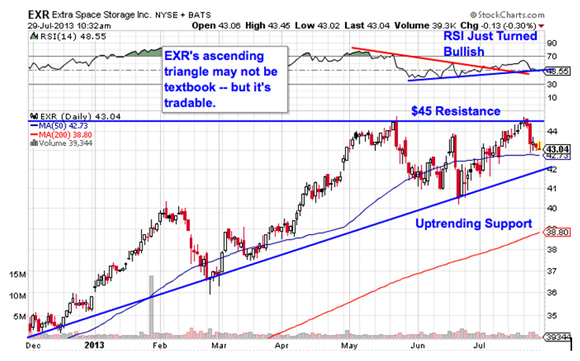
Up first is Extra Space Storage (EXR), a $5 billion self-storage facility owner. EXR has posted strong performance for 2013, rallying close to 19% since the calendar flipped over to January. That's more or less on par with the performance of the S&P, but it's a whole lot stronger than most REITs. That outsized relative strength looks ready to carry over to the second half of the year.

That's because EXR is currently forming an ascending triangle pattern, a price setup that's formed by a horizontal resistance level to the upside and uptrending support to the downside. Essentially, as shares of EXR bounce in between those two technical levels, they're getting squeezed closer and closer to a breakout above resistance -- at $45 in this case. When that breakout happens, traders have a buy signal in shares.

Hot Insurance Stocks For 2014

EXR's pattern isn't exactly textbook, but that doesn't change the trading implications in this stock. Momentum adds some extra confidence to EXR's ability to break out; 14-day RSI turned bullish just last week. After EXR clears $45, keep a tight protective stop in place.

Pebblebrook Hotel Trust

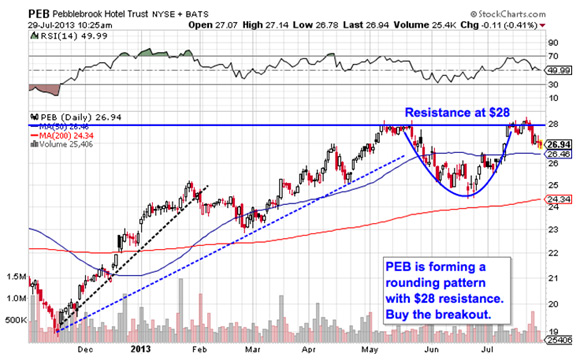
Small-cap hotel investment REIT Pebblebrook Hotel Trust (PEB) is setting up a similar pattern to the one in EXR -- with a few exceptions.

PEB isn't forming an ascending triangle; support isn't in the same sort of uptrend in this stock. Instead, PEB is forming a rounding pattern with resistance at $28. Rounding patterns look just like they sound -- they indicate a shift in control from sellers to buyers. While this setup is most common as a "bottoming" pattern, PEB's price action doesn't change the implications if shares can break out above $28. That's our buy signal.

Whenever you're looking at any technical price pattern, it's critical to think in terms of buyers and sellers. Triangles, rectangles and other price pattern names are a good quick way to explain what's going on in this stock, but they're not the reason it's tradable. Instead, it all comes down to supply and demand for shares.

That resistance line at $28 is a price where there's an excess of supply of shares; in other words, it's a place where sellers have been more eager to take recent gains and sell their shares than buyers have been to buy. That's what makes the move above it so significant -- a breakout indicates that buyers are finally strong enough to absorb all of the excess supply above that price level. Wait for that signal to happen before you jump into this stock.

Newcastle Investment

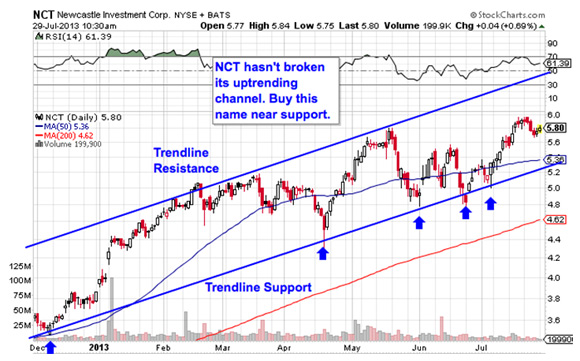
You don't have to be an expert technical analyst to figure out what's going on in shares of Newcastle Investment (NCT) -- a quick glance at the chart will do. NCT has been in an uptrend since the end of December, rallying as it got pushed by tailwinds in the real estate sector and then spun off its residential financing unit into New Residential Investment (NRZ) in May.

Adjusting shares of NCT for the spinoff gives us the chart above.

As you might expect, the best time to be a buyer in NCT is on a bounce off of support. Buying off a support bounce makes sense for two big reasons: It's the spot where shares have the furthest to move up before they hit resistance, and it's the spot where the risk is the least (because shares have the least room to move lower before you know you're wrong).

The fact that NCT has managed to clear its previous swing high from May speaks volumes about this stock's relative strength right now. Historically, high relative strength tends to continue to outperform the market for another three to 10 months. That puts NCT owners in a good position for the second part of 2013.

MFA Financial

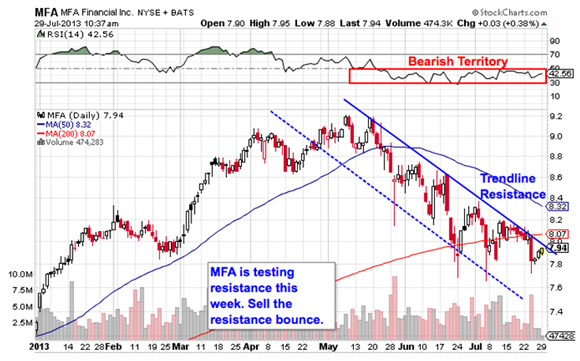
We're seeing the exact opposite setup in shares of MFA Financial (MFA). Unlike NCT, shares of MFA have been in a well-defined downtrend since the middle of May. That high probability range puts this stock's likely target price lower for the end of August.

Since the best time to buy an uptrend is at support, it makes sense that the best time to sell a stock in a downtrend is at trendline resistance. That's the exact level that MFA is testing this week. If you own MFA right now, it makes sense to be a seller on the first semblance of a bounce lower.

Momentum provides some extra confirmation here too. RSI has been suck down in bearish territory since the uptrend began in May. Oscillators like RSI tend to become range-bound when stocks' price action trends. I'd look for a move above 50 on RSI as a precondition to a move higher in price.

Retail Properties of America

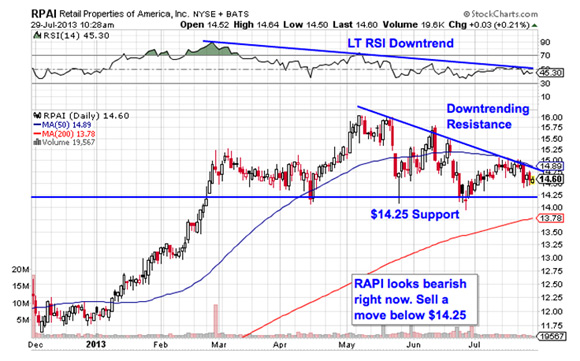
Last up is Retail Properties of America (RPAI), a $4 billion trust that owns and operates shopping centers. RPAI is another bearish setup right now -- shares are currently forming a descending triangle, the opposite of the bullish setup we looked at in EXR. Here's how to trade it.

The descending triangle is a price setup that's formed by horizontal support -- in this case at $14.25 -- and downtrending resistance. As shares get squeezed closer to that support level at $14.25, the probability is increasing that we'll see a breakdown below support. When that happens, it makes sense to sell (or short) shares. If you decide on the latter, it makes sense to keep a protective stop on the other side of the 50-day moving average -- it's acted as a decent proxy for resistance over the course of this setup.

Don't be early on this trade. The broad market is still in a primary uptrend, and that makes any shorts counter-trend trades right now. RPAI doesn't become a high probability downside name until that excess demand at $14.25 gets absorbed by sellers.

To see this week's trades in action, check out the Technical Setups for the Week portfolio on Stockpickr.

-- Written by Jonas Elmerraji in Baltimore.

Saturday, October 26, 2013

Top 5 Value Stocks To Own Right Now


Ford CEO Alan Mulally has turned around the automaker through excellent management decisions. Photo credit: Ford Motor Company.

I recently wrote a brief article regarding Ford's (NYSE: F  ) underfunded pension plan and how low discount rates have played a role in creating a huge obligation for the company. At the end of 2012, with discount rates at low levels, the company left an underfunded pension plan to the tune of $18.7 billion ��larger than Ford's automotive debt of $15.8 billion. What most people don't understand is how quickly this can turn around as rates rise.

Break it down
As discount rates rise, obligations decline ��simple right? But that doesn't put into perspective how much or how fast this can happen. For General Motors (NYSE: GM  ) , which has a pension plan underfunded by a staggering $27.8 billion, an increase of one percentage point in the discount rate would cut $8.76 billion from its obligation value, according to Automotive News. A similar rate increase would reduce Ford's obligation by $5.2 billion ��more than it has paid into the fund in the last two years combined.

Top 5 Value Stocks To Own Right Now: Schlumberger N.V.(SLB)

Schlumberger Limited, together with its subsidiaries, supplies technology, integrated project management, and information solutions to the oil and gas exploration and production industries worldwide. The company?s Oilfield Services segment provides exploration and production services; wireline technology that offers open-hole and cased-hole services; supplies engineering support, directional-drilling, measurement-while-drilling, and logging-while-drilling services; and testing services. This segment also offers well services; supplies well completion services and equipment; artificial lift; data and consulting services; geo services; and information solutions, such as consulting, software, information management system, and IT infrastructure services that support oil and gas industry. Its WesternGeco segment provides reservoir imaging, monitoring, and development services; and operates data processing centers and multiclient seismic library. This segment also offers variou s services include 3D and time-lapse (4D) seismic surveys to multi-component surveys for delineating prospects and reservoir management. The company?s M-I SWACO segment supplies drilling fluid systems to improve drilling performance; fluid systems and specialty tools to optimize wellbore productivity; production technology solutions to maximize production rates; and environmental solutions that manages waste volumes generated in drilling and production operations. Its Smith Oilfield segment designs, manufactures, and markets drill bits and borehole enlargement tools; and supplies drilling tools and services, tubular, completion services, and other related downhole solutions. The company?s Distribution segment markets pipes, valves, and fittings, as well as mill, safety, and other maintenance products. This segment also provides warehouse management, vendor integration, and inventory management services. Schlumberger Limited was founded in 1927 and is based in Houston, Texas.

Advisors' Opinion:
  • [By Dr. Kent Moors]

    That's why some of the biggest OFS providers - like Schlumberger (NYSE: SLB), Halliburton (NYSE: HAL) and Weatherford International (NYSE: WFT) - have been buying up oil and gas equipment companies.

  • [By Aaron Levitt]

    With fracking and advanced drilling techniques becoming the norm — both onshore and off — the firms that do all of that heavy lifting are set to win big over the longer term. And there are none bigger than Halliburton (HAL) and Schlumberger (SLB). Both remain the undisputed kingpins of fracking and oil services.

  • [By Tyler Crowe]

    Even though the country has so much oil, it has struggled to keep up production growth and has asked for outside help. This week, Venezuela has signed financing deals with Chevron (NYSE: CVX  ) , Schlumberger (NYSE: SLB  ) , and Russia's Rosneft that will total $5.6 to expand production. The country hopes to increase production from 3 to 5 million barrels per day by 2015.

Top 5 Value Stocks To Own Right Now: Tupperware Corporation(TUP)

Tupperware Brands Corporation operates as a direct seller of various products across a range of brands and categories through an independent sales force. The company engages in the manufacture and sale of kitchen and home products, and beauty and personal care products. It offers preparation, storage, and serving solutions for the kitchen and home, as well as kitchen cookware and tools, children?s educational toys, microwave products, and gifts under the Tupperware brand name primarily in Europe, Africa, the Middle East, the Asia Pacific, and North America. The company provides beauty and personal care products, which include skin care products, cosmetics, bath and body care, toiletries, fragrances, nutritional products, apparel, and related products principally in Mexico, South Africa, the Philippines, Australia, and Uruguay. It offers beauty and personal care products under the Armand Dupree, Avroy Shlain, BeautiControl, Fuller, NaturCare, Nutrimetics, Nuvo, and Swissgar de brand names. The company sells its Tupperware products directly to distributors, directors, managers, and dealers; and beauty products primarily through consultants and directors. As of December 26, 2009, the Tupperware distribution system had approximately 1,800 distributors, 61,300 managers, and 1.3 million dealers; and the sales force representing the Beauty businesses approximately 1.1 million. The company was formerly known as Tupperware Corporation and changed its name to Tupperware Brands Corporation in December 2005. The company was founded in 1996 and is headquartered in Orlando, Florida.

Advisors' Opinion:
  • [By Dan Caplinger]

    Where growth will come from
    One area that Newell Rubbermaid still has to tap fully is emerging markets. The company has done a good job of expanding overseas, with 17% annual growth in Latin America. But with barely a quarter of its sales coming from outside the U.S. and Canada, the company has a lot further to go. Storage rival Tupperware (NYSE: TUP  ) gets fully 60% of its total revenue from emerging markets, and it too has seen impressive gains in South America as well as the Asia-Pacific region.

  • [By Arie Goren]

    After running this screen on May 21, 2013, before the markets' open, I discovered the following eight stocks: Sunoco Logistics Partners LP (SXL), Leggett & Platt Inc (LEG), Copa Holdings SA (CPA), RPC Inc. (RES), Tupperware Brands Corp. (TUP), Herbalife Ltd. (HLF), John Wiley & Sons Inc. (JW.A) and C.H. Robinson Worldwide Inc. (CHRW).

Hot Tech Companies To Invest In Right Now: Caterpillar Inc.(CAT)

Caterpillar Inc. manufactures and sells construction and mining equipment, diesel and natural gas engines, industrial gas turbines, and diesel-electric locomotives worldwide. It operates through three lines of businesses: Machinery, Engines, and Financial Products. The Machinery business offers construction, mining, and forestry machinery, including track and wheel tractors, track and wheel loaders, pipelayers, motor graders, wheel tractor-scrapers, track and wheel excavators, backhoe loaders, log skidders, log loaders, off-highway trucks, articulated trucks, paving products, skid steer loaders, underground mining equipment, tunnel boring equipment, and related parts. It also manufactures diesel-electric locomotives; and manufactures and services rail-related products and logistics services for other companies. The Engines business provides diesel, heavy fuel, and natural gas reciprocating engines for Caterpillar machinery, electric power generation systems, marine, petrol eum, construction, industrial, agricultural, and other applications. It offers industrial turbines and turbine-related services for oil and gas, and power generation applications. This business also remanufactures Caterpillar engines, machines, and engine components; and offers remanufacturing services for other companies. The Financial Products business provides retail and wholesale financing alternatives for Caterpillar machinery and engines, solar gas turbines, and other equipment and marine vessels, as well as offers loans and various forms of insurance to customers and dealers. It also offers financing for vehicles, power generation facilities, and marine vessels. The company markets its products directly, as well as through its distribution centers, dealers, and distributors. It was formerly known as Caterpillar Tractor Co. and changed its name to Caterpillar Inc. in 1986. Caterpillar Inc. was founded in 1925 and is headquartered in Peoria, Illinois.

Advisors' Opinion:
  • [By Matt Thalman]

    The big losers
    Earth-moving company Caterpillar (NYSE: CAT  ) lost 0.42% of its value over the past few trading days, as precious metals and other natural resources had a terrible Friday. On the last day of the week alone, gold lost 3.13%, sliver declined by 4.89%, and platinum and copper slid 1.51% and 3.45% respectively. Caterpillar is a big player in mining equipment sales, and when the commodity prices of the resources which are mined fall, demand for heavy machinery usually will follow suit. �

  • [By Dan Caplinger]

    Finally, Caterpillar (NYSE: CAT  ) continued its poor performance, falling another 1.5% and coming closer to flirting with a new multi-year low. A minor bounce in precious metals prices has helped to reverse a small part of gold's big decline from earlier this year, bringing some hope that mining activity might rise and increase demand for Caterpillar's mining equipment. Yet, even amid signs of relative strength in the U.S., the economies of the rest of the world don't look nearly as perky, and that should keep a lid over Caterpillar's prospects until the trend reverses itself.

Top 5 Value Stocks To Own Right Now: Dollar Tree Inc.(DLTR)

Dollar Tree, Inc. operates discount variety stores in the United States and Canada. Its stores offer merchandise primarily at the fixed price of $1.00. The company operates its stores under the names of Dollar Tree, Deal$, Dollar Tree Deal$, Dollar Giant, and Dollar Bills. Its stores offer consumable merchandise, including candy and food, and health and beauty care, as well as household consumables, such as paper, plastics, household chemicals, in select stores, and frozen and refrigerated food; variety merchandise, which includes toys, durable housewares, gifts, party goods, greeting cards, softlines, and other items; and seasonal goods, such as Easter, Halloween, and Christmas merchandise. As of April 30, 2011, it operated 4,089 stores in 48 states and the District of Columbia, as well as 88 stores in Canada. The company was founded in 1986 and is based in Chesapeake, Virginia.

Advisors' Opinion:
  • [By Jacob Roche]

    With the economy starting to improve, you might think Dollar Tree's (NASDAQ: DLTR  ) fortunes will reverse. The deep discounter provided unemployed and lower-income consumers a safe place in the storm, but with the economic weather clearing up, it would be reasonable to expect consumers to venture out again to higher-end retailers. However, that assumption would be wrong.

  • [By Mani]

    Dollar Tree, Inc. (NASDAQ:DLTR) is one of the companies that are set to exploit the ongoing trend of consumers' increasing focus on value with significant opportunity to grow its store base, and expand margins.

Friday, October 25, 2013

Stocks to Watch: UPS, Newell Rubbermaid, National Oilwell

Among the companies with shares expected to actively trade in Friday’s session are United Parcel Service Inc.(UPS), Newell Rubbermaid Inc.(NWL) and National Oilwell Varco Inc.(NOV)

UPS’ third-quarter revenue rose on increased domestic and international shipments. Core earnings also climbed and just topped Street estimates, helping send shares up.

Newell Rubbermaid’s third-quarter earnings rose 78% after the consumer-products maker booked a gain on the sale of its hardware business. Shares climbed as the bottom line beat expectations.

National Oilwell’s third-quarter earnings rose 3.9%, buoyed by top-line growth throughout the oilfield-services equipment manufacturer’s operations. Results beat views and all three of its segments posted revenue gains. Shares rose.

Microsoft Corp.(MSFT) bucked a recent trend among major sellers of technology to corporations, posting double-digit percentage increases in both revenue and profit for the fiscal first quarter. The results easily topped Wall Street’s expectations, sending shares up.

Amazon.com Inc.(AMZN) reported its third quarterly loss in the past year after a more than nine-year run of profitable quarters. The online retailer, as expected, reported a big jump in revenue heading into the holiday season, its biggest quarter of the year. Shares rose.

Zynga Inc.'s(ZNGA) third-quarter loss narrowed as the social-game maker continued to slash expenses, though daily average users continued to decline. The stock, which has fallen sharply from its initial public offering price of $10 a share in late 2011, rose as the adjusted loss and bookings topped the company’s own forecast.

Top 5 High Tech Companies To Buy Right Now

Career Education Corp.(CECO) agreed to sell its European education properties to private equity firm Apax Partners for a total of $305 million. Shares of Career Education rose.

Qlik Technologies Inc.'s(QLIK) third-quarter earnings soared due to a tax benefit, but higher costs more than offset revenue growth. Shares dropped as revenue missed expectations and the company’s outlook for the current quarter was short of analysts’ estimates.

Outerwall Inc.'s(OUTR) third-quarter profit more than doubled on a gain tied to the company’s equity interest in ecoATM, which the kiosk operator fully acquired this summer. Shares jumped, as Outerwall’s results were mostly strong compared to the weak guidance it issued last month.

Healthways Inc.'s(HWAY) profit fell 64%, hurt by shrinking margins and flat revenue. Shares of Healthways fell as the company lowered its guidance for the year, while issuing downbeat estimates for the fourth quarter and 2014.

Deckers Outdoor Corp.'s(DECK) third-quarter profit slid 23% as the footwear maker reported sharply higher overhead expenses, masking higher sales of brands like Ugg and Teva. But the company’s shares jumped, as results exceeded Deckers’ July targets and the company issued rosy outlook commentary for the year.

DuPont Co.(DD) intends to spin off its performance chemicals segment to existing shareholders, a move that comes as some investors called on management to improve the company’s financial results. Shares rose.

Callaway Golf Co.'s(ELY) third-quarter loss narrowed significantly as the golf equipment maker reported a jump in sales and sharp increase in gross margins. Results for the period easily topped Wall Street’s expectations, sending shares up.

ResMed Inc.’s profit rose 9% in its fiscal first quarter, buoyed by revenue growth and widening margins. However, shares dropped as results came in below expectations.

Lear Corp.'s(LEA) third-quarter profit fell 7.1% due to higher expenses that masked revenue and margin growth at the automotive-seating and electric-systems company. But results easily beat estimates, and the company raised its full-year revenue guidance, sending shares up.

AbbVie Inc.'s(ABBV) third-quarter earnings fell 39% due to higher costs and expenses, offsetting strong revenue growth from key drug Humira. Results topped expectations, and the company raised the low end of its full-year adjusted earnings estimate. Shares rose.

Eastman Chemical Co.'s(EMN) third-quarter earnings surged as the diversified chemical and materials producer reported sales growth as well as fewer charges related to its acquisition of Solutia Inc. last year. But it lowered its earnings estimate for the year on expectations it will continue to face challenges in its adhesives and plasticizers business, as well as higher raw-materials and energy costs. Shares dropped.

Thursday, October 24, 2013

Thursday Closing Bell: Markets Close Higher on Hope for Better Days

October 24, 2013: U.S. markets opened higher Thursday morning and marched upward for most of the day. Today's report on new claims for unemployment benefits fell from the prior week and flash PMI reports on the Eurozone and the U.S. were weaker than expected. Still, a blizzard of quarterly earnings helped keep the markets buoyant today.

European markets closed higher today, Asian closed mixed, and Latin American closed lower.

Friday's calendar includes the following scheduled data releases and events (all times Eastern).

8:30 a.m. – Durable goods orders 9:55 a.m. – University of Michigan/Thomson Reuters consumer sentiment index 10:00 a.m. – Wholesale trade

Here are the closing bell levels for Thursday:

S&P500 1752.06 (+5.69; +0.33%) DJIA 15509.21 (+95.88; +0.62%) NASDAQ 3928.96 (+21.89; +0.56%) 10YR TNOTE 2.515% (-0.09375) Gold $1,350.30 (+16.30; +1.2%) WTI Crude oil $97.11 (+0.25; +0.3%) Euro/Dollar: 1.3802 (+0.0025; +0.18%)

Big Earnings Movers: AT&T Inc. (NYSE: T) is down 1.9% at $34.62 on earnings that were good but not great. Symantec Inc. (NASDAQ: SYMC) is down 12.8% at $21.48 on lagging revenues and a weak outlook. Fusion-io Inc. (NYSE: FIO) is down 24.4% at $9.81 on soft results. Goldcorp Inc. (NYSE: GG) is up 4% at $26.62 after reporting earnings this morning. Xerox Corp. (NYSE: XRX) is down 10.4% at $9.61 on a weak outlook tied to a failing turnaround plan.

Stocks on the Move: ParkerVision Inc. (NASDAQ: PRKR) is down 59.2% at $2.89 following a smaller-than-hoped-for award in its patent suit against Qualcomm Inc. (NASDAQ: QCOM). NQ Mobile Inc. (NYSE: NQ) is down 50.7% at $11.28 following a blistering from analysts at Muddy Waters.

In all, 211 NYSE stocks put up new 52-week highs today, while 9 stocks posted new lows.

Wednesday, October 23, 2013

Australia stocks inch higher as financials rebound

10 Best Low Price Stocks To Watch Right Now

LOS ANGELES (MarketWatch) -- Australian stocks nudged modestly higher early Thursday, with a rebound for financials offsetting weakness in the resource space. The S&P/ASX 200 (AU:XJO) advanced 0.1% to 5,361.80, as banks and brokers gained after losing ground late in the previous session on concerns about the health of major Chinese banks. Commonwealth Bank of Australia (AU:CBA) (CBAUF) and Macquarie Group Ltd. (AU:MQG) (MCQEF) rose 0.7% apiece, Australia & New Zealand Banking Group (AU:ANZ) (ANEWF) added 0.5%, and Westpac Banking Corp. (AU:WBC) (WEBNF) improved by 0.5%. On the downside, losses for gold futures overnight sent Newcrest Mining Ltd. (AU:NCM) (NCMGF) down 1.3% and Evolution Mining Ltd. (AU:EVN) (CAHPF) 2.3% lower. The broader mining sector was also lower, with Alumina Ltd. (AU:AWC) (AWCMF) off 2.8%, BHP Billiton Ltd. (AU:BHP) (BHP) down 0.5%, and Fortescue Metals Group Ltd. (AU:FMG) (FSUMF) losing 1.4%. Meanwhile, preliminary Chinese manufacturing data due out later Thursday from HSBC could impact the Australian resource shares.

David Rolfe Comments on Monster Beverage

Monster Beverage (MNST)

Monster Beverage detracted from performance as revenue growth decelerated in the face of negative press related to the safety profile of energy drinks. Despite this transient headwind, the brand continues to take share, profitably, from traditional carbonated soft drinks. We continue to expect the Company's growth profile, over a multi-year period, will eclipse double-digits, despite periodic negative press. Energy drinks continue to be a highly disruptive offering in the beverage industry, driven by a generational shift in preference for caffeinated products. While the level of caffeine in the typical Monster Energy drink is higher than most traditional carbonated soft drinks, it has half as much (per ounce) than most popular coffee house offerings. We believe this relatively new value proposition should position Monster to continue taking share from traditional beverage incumbents.

From David Rolfe's Wedgewood Partners third quarter 2013 commentary.


Related links:Third quarter 2013 commentary

Tuesday, October 22, 2013

What Is Market Efficiency?

When money is put into the stock market, the goal is to generate a return on the capital invested. Many investors try not only to make a profitable return, but also to outperform, or beat, the market.

However, market efficiency - championed in the efficient market hypothesis (EMH) formulated by Eugene Fama in 1970, suggests that at any given time, prices fully reflect all available information on a particular stock and/or market. Fama was awarded the Nobel Memorial Prize in Economic Sciences jointly with Robert Shiller and Lars Peter Hansen in 2013. According to the EMH, no investor has an advantage in predicting a return on a stock price because no one has access to information not already available to everyone else.

The Effect of Efficiency: Non-Predictability
The nature of information does not have to be limited to financial news and research alone; indeed, information about political, economic and social events, combined with how investors perceive such information, whether true or rumored, will be reflected in the stock price. According to the EMH, as prices respond only to information available in the market, and because all market participants are privy to the same information, no one will have the ability to out-profit anyone else.

In efficient markets, prices become not predictable but random, so no investment pattern can be discerned. A planned approach to investment, therefore, cannot be successful.

This "random walk" of prices, commonly spoken about in the EMH school of thought, results in the failure of any investment strategy that aims to beat the market consistently. In fact, the EMH suggests that given the transaction costs involved in portfolio management, it would be more profitable for an investor to put his or her money into an index fund.

Anomalies: The Challenge to Efficiency
In the real world of investment, however, there are obvious arguments against the EMH. There are investors who have beaten the market - Warren Buffett, whose investment strategy focuses on undervalued stocks, made billions and set an example for numerous followers. There are portfolio managers who have better track records than others, and there are investment houses with more renowned research analysis than others. So how can performance be random when people are clearly profiting from and beating the market?

Counter arguments to the EMH state that consistent patterns are present. For example, the January effect is a pattern that shows higher returns tend to be earned in the first month of the year; and the weekend effect is the tendency for stock returns on Monday to be lower than those of the immediately preceding Friday.

Studies in behavioral finance, which look into the effects of investor psychology on stock prices, also reveal that investors are subject to many biases such as confirmation, loss-aversion and overconfidence biases.

The EMH Response
The EMH does not dismiss the possibility of market anomalies that result in generating superior profits. In fact, market efficiency does not require prices to be equal to fair value all the time. Prices may be over- or undervalued only in random occurrences, so they eventually revert back to their mean values. As such, because the deviations from a stock's fair price are in themselves random, investment strategies that result in beating the market cannot be consistent phenomena.

Furthermore, the hypothesis argues that an investor who outperforms the market does so not out of skill but out of luck. EMH followers say this is due to the laws of probability: at any given time in a market with a large number of investors, some will outperform while others will underperform.

How Does a Market Become Efficient?
For a market to become efficient, investors must perceive that the market is inefficient and possible to beat. Ironically, investment strategies intended to take advantage of inefficiencies are actually the fuel that keeps a market efficient.

A market has to be large and liquid. Accessibility and cost information must be widely available and released to investors at more or less the same time. Transaction costs have to be cheaper than an investment strategy's expected profits. Investors must also have enough funds to take advantage of inefficiency until, according to the EMH, it disappears again.

Degrees of Efficiency
Accepting the EMH in its purest form may be difficult; however, three identified EMH classifications aim to reflect the degree to which it can be applied to markets:

1. Strong efficiency - This is the strongest version, which states that all information in a market, whether public or private, is accounted for in a stock price. Not even insider information could give an investor an advantage.
2. Semi-strong efficiency - This form of EMH implies that all public information is calculated into a stock's current share price. Neither fundamental nor technical analysis can be used to achieve superior gains.
3. Weak efficiency - This type of EMH claims that all past prices of a stock are reflected in today's stock price. Therefore, technical analysis cannot be used to predict and beat a market.

The Bottom Line
In the real world, markets cannot be absolutely efficient or wholly inefficient. It might be reasonable to see markets as essentially a mixture of both, wherein daily decisions and events cannot always be reflected immediately into a market. If all participants were to believe that the market is efficient, no one would seek extraordinary profits, which is the force that keeps the wheels of the market turning.

In the age of information technology (IT), however, markets all over the world are gaining greater efficiency. IT allows for a more effective, faster means to disseminate information, and electronic trading allows for prices to adjust more quickly to news entering the market. However, while the pace at which we receive information and make transactions quickens, IT also restricts the time it takes to verify the information used to make a trade. Thus, IT may inadvertently result in less efficiency if the quality of the information we use no longer allows us to make profit-generating decisions.

Monday, October 21, 2013

Why the Dow Will Close Higher

Blue-chip stocks are making up at least some of the ground lost over the last few weeks, thanks to better-than-expected data on durable-goods orders and home sales. With roughly an hour left in the trading session, the Dow Jones Industrial Average (DJINDICES: ^DJI  ) is up by 107 points, or 0.73%.

A bevy of reports from the housing sector seems to be the clear impetus for investors' optimism. The Federal Housing Finance Agency released statistics (link opens PDF) this morning showing that home prices around the country rose by 0.7% in April over the preceding month and 7.4% from the same month last year. The direction of home prices was confirmed by a separate Standard & Poor's report (link opens PDF) that estimated sequential and annual increases of 2.5% and 12.1%, respectively.

According to an economist quoted by Bloomberg News: "Housing's doing really well and I don't think the backup in mortgage rates to date is going to derail it. We're still well off the highs, but price increases could continue for the next several years."

Furthermore, the Department of Commerce today released its estimate (link opens PDF) for new-home sales in the month of May. The data showed that sales of new single-family houses came in at a seasonally adjusted annual rate of 476,000 last month. That's 2.1% better than the revised rate for April and a staggering 29% higher than May of 2012.

And if this weren't enough, the nation's third-largest homebuilder by unit sales, Lennar (NYSE: LEN  ) , released earnings for its fiscal second quarter. Thanks in large part to the preceding trends, Lennar had a good quarter: Among other things, its year-over-year deliveries of new homes surged by 39%, new orders rose by 27%, and its backlog spiked 55%.

As CEO Stuart Miller observed, "Against the backdrop of recent investor concerns over mortgage rate increases, we believe that our second quarter results together with real time feedback from our field associates continue to point toward a solid housing recovery."

On a separate economic front, the Department of Commerce reported (link opens PDF) this morning that new orders for manufactured economic goods -- an important economic gauge -- increased last month by 3.6% over April. And the Commerce Board said its index of consumer confidence rose to 81.4 this month from a reading of 74.3 in May. The measure is now at its highest level since January of 2008.

With all this data in mind, it's little surprise that stocks are reclaiming lost ground today. At present, 27 of the Dow's 30 components are in the green, with only Microsoft, Merck, and UnitedHealth Group down.

The best-performing component is Bank of America (NYSE: BAC  ) , the nation's second-largest bank by assets. B of A's performance, as well as that of other banks, is tied in large part to the health of the housing market. Higher home prices increase the value of collateral and reduce delinquency and foreclosure rates. And higher new-home sales boost mortgage-underwriting activity -- a lucrative source of non-interest income for most banks. At present, shares of Bank of America are up by 3%.

Meanwhile, one of the worst-performing stocks in the broader market today is Barnes & Noble (NYSE: BKS  ) , down more than 17%. The ailing bookseller announced its fiscal fourth-quarter earnings today, revealing just how much trouble it's in. Revenue in its Nook division fell by 34% for the quarter, while same-store sales dropped 8.8%. In response, the company said it will stop producing the tablet versions of its Nook product line.

Sunday, October 20, 2013

Apple Reports Up to 5,000 Government Requests for Data

Following recent controversy surrounding the U.S. government's "Prism" program, Apple (NASDAQ: AAPL  ) has detailed its policies and information surrounding customer privacy and government data collection.

After obtaining permission from the federal government to release the information, the company said that between Dec. 1, 2012, and May 31, 2013, it had received between 4,000 and 5,000 requests from U.S. law enforcement for customer data, which included 9,000 to 10,000 specific accounts or devices. The requests came from federal, state, and local authorities and related to criminal investigations and national security, according to Apple.

"The most common form of request comes from police investigating robberies and other crimes, searching for missing children, trying to locate a patient with Alzheimer's disease, or hoping to prevent a suicide," said the company. Apple said it does not provide any government agency with direct access to its servers, and any government agency requesting customer content must get a court order.

10 Best Growth Stocks To Buy Right Now

Apple said it evaluates each request and only releases the minimum amount of data possible, and occasionally refuses to release information if it sees "inconsistencies or inaccuracies." The company also noted that certain data, such as iMessage and FaceTime conversations, are protected with end-to-end encryption that not even Apple can decrypt. Apple also doesn't store location data, Map searches, or Siri requests in "any identifiable form," it said.

The disclosure follows similar ones from peers like Microsoft and Facebook. For the six-month period ending Dec. 12, 2012, Microsoft received between 6,000 and 7,000 national or criminal security warrants, subpoenas, and orders, that company said. Facebook reported that it received between 9,000 and 10,000 government security requests for data during the six-month period ending Dec. 31, 2012. The security requests affected between 18,000 and 19,000 customer accounts, according to Facebook.

link

Thursday, October 17, 2013

Meet the New All-Time High on the S&P 500 Index (Updated)

This story has been updated from the 1:28 p.m. EST post time to reflect a new all-time high.

The DJIA may be stuck in the mud because of its huge weighting of International Business Machines Corp. (NYSE: IBM) but the S&P 500 Index has now challenged and broken out to a new all-time high. One of the trends we identified that the D.C. settlement will not change is that this bull market in equities is likely to keep running higher and higher.

The S&P 500 was up about 6 points at 1,727.50 as of 1:20 p.m. EST and Thursday’s trading range had been 1,714.12 to 1,729.64 and the 52-week trading range is 1,343.35 to 1,729.86. The new all-time high is 1,730.24!!!

The S&P 500 was within 0.22 of reaching an all-time high earlier but has put in a new high now. This stock market never did get hit too hard during the height of the Washington panic, and we were never on the verge of a stock market crash. This is telling you something, and you should be listening to what it is telling you.

If you have really bad news in the works and an opportunity for the wheels to come off the wagon and nothing bad happens in the stock market, the market is telling you that it wants to surge higher. That is just the way it always has been and likely will be ahead.

Below is my market tweet @jonogg on the DJIA versus the S&P 500. Stay tuned.

Ogg Tweet Oct 17Source: Twitter.com/JonOgg

Wednesday, October 16, 2013

5 Stocks With Big Insider Buying

DELAFIELD, Wis. (Stockpickr) -- Corporate insiders sell their own companies' stock for a number of reasons.

>>5 Stocks Set to Soar on Bullish Earnings

They might need the cash for a big personal purchase such as a new house or yacht, or they might need the cash to fund a charity. Sometimes they sell as part of a planned selling program that they have put in place for diversification purposes, which allows them to sell stock in stages instead of selling all at one price.

Other times they sell because they think their stock is overvalued and the risk/reward is no longer attractive. Some even dump their own stock because they have inside knowledge that a competitor is eating their lunch and stealing market share.

But insiders usually buy their own shares for one reason: They think the stock is a bargain and has tremendous upside.

>>The Pros Hate These Stocks -- Should You?

The key word in that last statement is "think." Just because a corporate insider thinks his or her stock is going to trade higher, that doesn't mean it will play out that way. Insiders can have all the conviction in the world that their stock is a buy, but if the market doesn't agree with them, the stock could end up going nowhere. Also, I say "usually" because sometimes insiders are loaned money by the company to buy their own stock. Those loans are often sweetheart deals and shouldn't be viewed as organic insider buying.

At the end of the day, its large institutional money managers running big mutual funds and hedge funds that drive stock prices, not insiders. That said, many of these savvy stock operators will follow insider buying activity when they agree with the insider that the stock is undervalued and has upside potential. This is why it's so important to always be monitoring insider activity, but it's twice as important to make sure the trend of the stock coincides with the insider buying.

>>5 Rocket Stocks to Buy This Earnings Season

Recently, a number of companies' corporate insiders have bought large amounts of stock. These insiders are finding some value in the market, which warrants a closer look at these stocks. Here's a look at five stocks whose insiders have been doing some big buying per SEC filings.

Vitran

One ground freight player that insiders are loading up on here is Vitran (VTNC), a provider of less-than-truckload services throughout Canada and in 34 states in the U.S. Insiders are buying this stock into decent strength, since shares are up 17% so far in 2013.

Vitran has a market cap of $93.51 million and an enterprise value of $133.77 million. This stock trades at a cheap valuation, with a trailing price-to-earnings of 3.78 and a forward price-to-earnings of 15. Its estimated growth rate for this year is -88%, and for next year it's pegged at 112.2%. This is not a cash-rich company, since the total cash position on its balance sheet is $41.24 million and its total debt is $82.98 million.

>>5 Stocks With Breakout Potential

A beneficial owner just bought 489,461 shares, or about $2.57 million worth of stock, at $5.18 to $5.30 per share.

From a technical perspective, VTNC is currently trending above both its 50-day and 200-day moving averages, which is bullish. This stock has been uptrending strong for the last few weeks, with shares soaring higher from its low of $3.89 to its recent high of $5.80 a share. During that uptrend, shares of VTNC have been consistently making higher lows and higher highs, which is bullish technical price action.

If you're bullish on VTNC, then I would look for long-biased trades as long as this stock is trending above some near-term support at $5.25 or at $5 and then once breaks out above some near-term overhead resistance at $5.80 a share with high volume. Look for a sustained move or close above that level with volume that hits near or above its three-month average action of 123,158 shares. If that breakout hits soon, then VTNC will set up to re-test or possibly take out its next major overhead resistance levels at $6.69 to its 52-week high at $7.73 a share.

Cosi

Another stock that insiders are jumping into here is Cosi (COSI), which owns, operates and franchises premium convenience restaurants that sell hot and cold sandwiches, freshly-tossed salads, breakfast wraps, hot melts, flatbread pizzas, desserts and a variety of coffees. Insiders are buying this stock into weakness, since shares are off by 27% so far in 2013.

>>5 Under-$10 Stocks Moving Much Higher

Cosi has a market cap of $40.53 million and an enterprise value of $28.75 million. This stock trades at a reasonable valuation, with a price-to-sales of 0.43 and a price-to-book of 4.31. Its estimated growth rate for this year is 17.9%, and for next year it's pegged at 73.9%. This is a cash-rich company, since the total cash position on its balance sheet is $11.96 million and its total debt is zero.

A beneficial owner just bought 246,511 shares, or about $537,000 worth of stock, at $2.17 to $2.20 per share.

From a technical perspective, COSI is currently trending below both its 50-day and 200-day moving averages, which is bearish. This stock has been trending sideways and consolidating for the last four months, with shares moving between $1.90 on the downside and $2.70 on the upside. Shares of COSI are now starting to uptick and move within range of breaking out above the upper-end of its sideways trading chart pattern.

If you're in the bull camp on COSI, then look for long-biased trades as long as this stock is trending above some key near-term support levels at $2.13 to $2, and then once it breaks out above some near-term overhead resistance levels at $2.33 to $2.38 a share, and then above $2.70 a share with high volume. Look for a sustained move or close above those levels with volume that hits near or above its three-month average action of 70,846 shares. If we get that move soon, then COSI will set up to re-test or possibly take out its next major overhead resistance levels at $3.19 to its 52-week high at $3.92 a share.

Puma Biotechnology

One development-stage biopharmaceutical player that insiders are loading up on here is Puma Biotechnology (PBYI), which acquires and develops innovative products for the treatment of various forms of cancer. Insiders are buying this stock into major strength, since shares are up sharply by 134% in 2013.

Puma Biotechnology has a market cap of 1.26 billion and an enterprise value of $1.17 billion. This stock trades at a premium valuation, with a price-to-book of 11.42. Its estimated growth rate for this year is 47.1%, and for next year it's pegged at -23.8%. This is a cash-rich company, since the total cash position on its balance sheet is $107.52 million and its total debt is zero.

>>Why I'm Sticking By Dow 55,000

A beneficial owner just bought 140,900 shares, or about $5.69 million worth of stock, at $39.97 to $40.08 per share.

From a technical perspective, PBYI is currently trending below its 50-day moving average and above its 200-day moving averages, which is neutral trendwise. This stock has recently been sold off sharply with volume from its high of $57.73 to its low of $38.94 a share. That low corresponded with PBYI's 200-day moving average, which for now has held as support. Shares of PBYI have started to rebound off that $38.94 low, and it's now moving within range of triggering a near-term breakout trade.

If you're bullish on PBYI, then look for long-biased trades as long as this stock is trending above its 200-day at $39, and then once it breaks out above some near-term overhead resistance at $44.98 a share with high volume. Look for a sustained move or close above that level with volume that hits near or above its three-month average volume of 156,625 shares. If that breakout triggers soon, then PBYI will set up to re-test or possibly take out its next major overhead resistance levels at its 50-day of $52.53 to $57.73 a share.

Yum! Brands

Another stock that insiders are snapping up a large amount of stock in here is Yum! Brands (YUM), which develops, operates, franchises and licenses a worldwide system of restaurants which prepare, pack and sell a menu of food items. Insiders are buying this stock into notable weakness, since shares are down by 7.3% during the last three months.

Yum! Brands has a market cap of $29.5 billion and an enterprise value of $31.9 billion. This stock trades at a fair valuation, with a trailing price-to-earnings of 27.81 and a forward price-to-earnings of 18.39. Its estimated growth rate for this year is -10.2%, and for next year it's pegged at 23.6%. This is not a cash-rich company, since the total cash position on its balance sheet is $753 million and its total debt is $2.93 billion. This stock currently sports a dividend yield of 2.2%.

>>5 Stocks Hedge Funds Love This Fall

A director just bought 20,000 shares, or about $1.32 million worth of stock, at $66.09 per share.

From a technical perspective, YUM is currently trending below both its 50-day and 200-day moving averages, which is bearish. This stock recently gapped down sharply from around $72 to $64.92 a share with heavy downside volume. Following that gap down, shares of YUM have stabilized a bit and trended range bound between $66 and $67 a share.

If you're bullish on YUM, then look for long-biased trades as long as this stock is trending above that recent low of $64.92, and then once it breaks out above some key near-term overhead resistance at $67.15 a share with high volume. Look for a sustained move or close above that level with volume that hits near or above its three-month average volume of 2.82 million shares. If that breakout hits soon, then YUM will set up to re-fill some of its previous gap down zone that started near $72. Shares of YUM could even tag $74 to $75 if that gap gets filled with strong upside volume flows.

ChemoCentryx

One more stock with some big insider buying activity is ChemoCentryx (CCXI), a biopharmaceutical company engaged in discovering, developing and commercializing orally-administered therapeutics to treat autoimmune diseases, inflammatory disorders and cancer. Insiders are buying this stock into major weakness, since shares are off by 52% so far in 2013.

>>4 Stocks Spiking on Big Volume

ChemoCentryx has a market cap of $221 million and an enterprise value of $93 million. This stock trades at a premium valuation, with a price-to-sales of 31.37 and a price-to-book of 1.38. Its estimated growth rate for this year is 8.8, and for next year it's pegged at -16.5%. This is a cash-rich company, since the total cash position on its balance sheet is $129.77 million and its total debt is just $618,000.

A beneficial owner just bought 1.3 million shares, or about $6.88 million worth of stock, at $5.26 per share.

From a technical perspective, CCXI is currently trending below both its 50-day and 200-day moving averages, which is bearish. This stock has been downtrending badly for the last three months, with shares plunging lower from its high of $14.75 to its low of $5.04 a share. During that downtrend, shares of CCXI have been consistently making lower highs and lower lows, which is bearish technical price action. That said, shares of CCXI have now moved into oversold territory, since its current relative strength index reading is 25.58. Oversold can always get more oversold, but it's also an area where a stock can experience a powerful bounce higher from.

If you're bullish on CCXI, then look for long-biased trades as long as this stock is trending its recent low of $5.04 and then once it breaks out above near-term overhead resistance levels $5.41 to $5.90 a share with high volume. Look for a sustained move or close above those levels with volume that hits near or above its three-month average action of 472,123 shares. If that breakout triggers soon, then CCXI will set up to re-test or possibly take out its next major overhead resistance levels at $6.45 to $7. Any high-volume move above $7 will then give CCXI a chance to re-fill some of its previous gap down zone from September that started near $8.50 a share.

To see more stocks with notable insider buying, check out the Stocks With Big Insider Buying portfolio on Stockpickr.

-- Written by Roberto Pedone in Delafield, Wis.


RELATED LINKS:


>>5 Hated Earnings Stocks You Should Love


>>5 Big Stocks to Trade for Big Gains


>>5 Stocks Under $10 in Breakout Territory

Follow Stockpickr on Twitter and become a fan on Facebook.

At the time of publication, author had no positions in stocks mentioned.

Roberto Pedone, based out of Delafield, Wis., is an independent trader who focuses on technical analysis for small- and large-cap stocks, options, futures, commodities and currencies. Roberto studied international business at the Milwaukee School of Engineering, and he spent a year overseas studying business in Lubeck, Germany. His work has appeared on financial outlets including

CNBC.com and Forbes.com. You can follow Pedone on Twitter at www.twitter.com/zerosum24 or @zerosum24.


Tuesday, October 15, 2013

Fitch issues warning on U.S. credit rating

Fitch Ratings said Tuesday it has placed its top rating on U.S. government's long-term debt on review for a possible downgrade, citing the drawn-out debate over raising the nation's debt limit.

"Although Fitch continues to believe that the debt ceiling will be raised soon, the political brinkmanship and reduced financing flexibility could increase the risk of a U.S. default," the ratings agency said.

The Treasury Department has said the emergency measures it has been using to manage the nation's finances under the existing debt limit will run out Thursday.

Without an increase in the nation's ability to borrow money to pay bills, "the U.S. risks being forced to incur widespread delays of payments to suppliers and employees, as well as social security payments to citizens - all of which would damage the perception of U.S. sovereign creditworthiness and the economy," Fitch said.

Fitch said it could make a decision on whether to lower its AAA rating on U.S. debt by the end of the first quarter.

"The announcement reflects the urgency with which Congress should act to remove the threat of default hanging over the economy," the Treasury Department said.

Political brinksmanship was incorporated into Standard &Poor's downgrade of the U.S. from AAA to AA+ in 2011, so far the only one of the major ratings agencies to give the U.S. less than a top rating on its debt. But the lack of an agreement on the debt limit this week would not necessarily trigger another S&P downgrade.

"Passing (Oct.) 17th is not a specific trigger in terms of a ratings change," says John Piecuch, spokesman for Standard & Poor's.

If the U.S, missed a debt payment, however, its rating would be lowered to selective default, Piechuch says.

Governments typically don't default on all their debt, as companies in bankruptcy do.

Contributing: John Waggoner

Monday, October 14, 2013

Top Canadian Stocks To Buy Right Now

Few stocks are as levered to the success of the Canadian oil sands as Baytex Energy (BTE). Baytex is a Canadian E&P company. The vast majority of Baytex's production comes from heavy oil, which is also sometimes known as thermal oil. The spread between heavy oil prices and WTI has recently narrowing significantly. I anticipate that Baytex will be reporting much stronger Q2 2013 earnings when compared with Q1 due primarily to improvements in its realized prices for its energy production. Baytex has not had a good 2013, with the stock down 4.5% YTD. However, in the past month it has gained about 13%. Baytex currently offers a $0.22 per share monthly dividend and yields about 6.10%.

(click to enlarge)

Top Canadian Stocks To Buy Right Now: Enbridge Inc(ENB)

Enbridge Inc. engages in the transportation and distribution of crude oil and natural gas primarily in Canada and the United States. Its Liquids Pipelines segment operates common carrier and contract crude oil, natural gas liquids (NGLs), and refined products pipelines and terminals. The company?s Gas Distribution segment distributes natural gas to residential, commercial, and industrial customers primarily in central and eastern Ontario, northern New York State, Quebec, and New Brunswick. Enbridge?s Gas Pipelines, Processing and Energy Services segment invests in natural gas pipelines, processing and green energy projects, and commodity marketing businesses, as well as performs commodity storage, transport, and supply management services. Its Sponsored Investments segment transports crude oil and other liquid hydrocarbons through common carrier and feeder pipelines, as well as transports, gathers, processes, and markets natural gas and NGLs; operates a crude oil and liqui ds pipeline and gathering system; and owns a 50% interest in the Canadian portion of Alliance Pipeline and partial interests in various green energy investments. The company was formerly known as IPL Energy Inc. and changed its name to Enbridge Inc. in October 1998. Enbridge Inc. was founded in 1949 and is headquartered in Calgary, Canada.

Advisors' Opinion:
  • [By Aimee Duffy]

    The Seaway pipeline, the joint venture between�Enterprise Products Partners (NYSE: EPD  ) and Enbridge (NYSE: ENB  ) , has taken on a life of its own, as speculators are trying to gain access to the last bit of capacity to sell the space on a secondary market. In this video, Fool.com contributor Aimee Duffy explains what is going on and why this pipeline matters so much to oil producers and investors alike.

Top Canadian Stocks To Buy Right Now: STMicroelectronics N.V.(STM)

STMicroelectronics N.V., an independent semiconductor company, engages in the design, development, manufacture, and marketing of a range of semiconductor integrated circuits and discrete devices. Its products include discrete and standard commodity components, application-specific integrated circuits, custom devices and semi-custom devices, and application-specific standard products for analog, digital, and mixed-signal applications. The company also offers subsystems and modules for the telecommunications, automotive, and industrial markets comprising mobile phone accessories, battery chargers, ISDN power supplies, and in-vehicle equipment for electronic toll payment, as well as provides Smartcard products. Its products are used in various microelectronic applications consisting of automotive products, computer peripherals, telecommunications systems, consumer products, industrial automation, and control systems. The company sells its products through distributors and ret ailers. STMicroelectronics N.V. was founded in 1987 and is headquartered in Geneva, Switzerland.

Advisors' Opinion:
  • [By Seth Jayson]

    STMicroelectronics (NYSE: STM  ) reported earnings on July 22. Here are the numbers you need to know.

    The 10-second takeaway
    For the quarter ended June 29 (Q2), STMicroelectronics met expectations on revenues and missed expectations on earnings per share.

Top 5 Performing Companies For 2014: Crown Castle International Corporation (CCI)

Crown Castle International Corp., through its subsidiaries, owns, operates, and leases towers and other wireless infrastructure primarily in the United States and Australia. Its infrastructure includes distributed antenna system (DAS) networks, as well as rooftop installations. The company involves in the rental of antenna space of its towers to wireless communications companies. It also provides network services relating to its towers, which primarily include antenna installations and subsequent augmentations, as well as additional services, such as site acquisition, architectural and engineering, zoning and permitting, other construction, and other services related network development. As of December 31, 2010, it owned, leased, or managed approximately 23,900 towers, including 43 completed DAS networks. The company was founded in 1994 and is headquartered in Houston, Texas.

Advisors' Opinion:
  • [By Brian Stoffel]

    4. Crown Castle International (NYSE: CCI  ) , P/E of 140
    Crown is one of the major players in the industry. By "tower industry," I'm referring to the towers that now dot our landscape to help ensure wireless data can be transmitted with ease.�

  • [By Jon C. Ogg]

    We just gave a fresh synopsis of which telecom and wireless players could still be up for M&A in the final round of consolidation. American Tower’s market cap is about $28 billion and shares are up more than 4.5% at $71.75. To show how hard things have been, the 52-week trading range is $67.89 to $85.26. What today’s transaction does is quite simply add value to the rest of the public companies that own and operate cell towers:

    Crown Castle International Corp. (NYSE: CCI) is up almost 2.5% at $70.90, against a 52-week range of $63.16 to $81.16. SBA Communications Corp. (NASDAQ: SBAC) is up about 1.8% at $76.70. against a 52-week range of $59.00 to $82.31.

    American Tower expects that the portfolio addition will generate about $345 million in revenues and approximately $270 million of gross margin in 2014. If you value the deal solely on the 5,400 or so owned U.S. towers, this comes up to about $611,000 per tower before calculating the debt and other rights. Suddenly, SBA Communications Corp. (NASDAQ: SBAC) is vindicated because a deal it made in 2012 was deemed pricey as it paid about $1.45 billion for 3,252 towers from TowerCo, at about $445,000 per tower. Crown Castle also has spent close to $2.4 billion to acquire T-Mobile cell tower rights in late 2012.

  • [By CRWE]

    Crown Castle International Corp. (NYSE:CCI) plans to release its third quarter 2012 results on Wednesday, October 24, 2012, after the market closes. In conjunction with the release, Crown Castle has scheduled a conference call for Thursday, October 25, 2012, at 10:30 a.m. Eastern Time.

Top Canadian Stocks To Buy Right Now: UniSource Energy Corporation(UNS)

UniSource Energy Corporation engages in the electric generation and energy delivery businesses. The company?s TEP segment generates, transmits, and distributes electricity to approximately 403,000 retail electric customers, including residential, commercial, industrial, and public sector customers in southeastern Arizona. It also sells electricity to other utilities and power marketing entities. As of December 31, 2010, this segment owned or leased 2,245 MW of net generating capacity, as well as owned or participated in electric transmission and distribution system consisting of 512 circuit-miles of 500-kV lines; 1,087 circuit-miles of 345-kV lines; 379 circuit-miles of 138-kV lines; 478 circuit-miles of 46-kV lines; and 2,621 circuit-miles of lower voltage primary lines. TEP segment generates electricity from coal, gas, oil, and solar sources. The company?s UNS Gas segment distributes gas to approximately 146,500 retail customers in Mohave, Yavapai, Coconino, and Navajo c ounties in northern Arizona, as well as Santa Cruz County in southeastern Arizona. As of December 31, 2010, this segment?s transmission and distribution system consisted of approximately 30 miles of steel transmission mains, 4,211 miles of steel and plastic distribution piping, and 136,439 customer service lines. The company?s UNS Electric segment transmits and distributes electricity to approximately 91,000 retail customers consisting of residential, commercial, and industrial customers in Mohave and Santa Cruz counties. As of December 31, 2010, UNS Electric?s transmission and distribution system consisted of approximately 56 circuit-miles of 115-kV transmission lines, 271 circuit-miles of 69-kV transmission lines, and 3,599 circuit-miles of underground and overhead distribution lines. This segment also owns the 65 MW Valencia plant, as well as 39 substations having an installed capacity of 1,788,050 kilovolt amperes. The company was founded in 1902 and is based in Tucson, Arizona.

Top Canadian Stocks To Buy Right Now: Nexen Inc.(NXY)

Nexen Inc. operates as an independent energy company worldwide. The company?s Conventional Oil and Gas segment explores for, develops, and produces crude oil and natural gas from conventional sources. This segment operates in the United Kingdom, Canada and the United States, and offshore West Africa, Colombia, and Yemen. Nexen?s Oil Sands segment develops and produces synthetic crude oil from the Athabasca oil sands in northern Alberta. The company?s Shale Gas segment explores for and produces unconventional gas from shale formations in northeastern British Columbia. Nexen Inc. was founded in 1971 and is headquartered in Calgary, Canada.

Top Canadian Stocks To Buy Right Now: MicroFinancial Incorporated(MFI)

Microfinancial Incorporated, through its subsidiaries, operates as a specialized commercial finance company that provides microticket equipment leasing and rental, and other financing services in the United States. The company provides financing alternatives, and leases and rents commercial equipment to start-up and established businesses for use in their daily operations. It leases water filtration systems, food service equipment, security equipment, point-of-sale cash registers, salon equipment, health care and fitness equipment, and automotive equipment. The company primarily sources its originations through a network of independent equipment vendors, sales organizations, and other dealer-based origination networks. Microfinancial Incorporated was founded in 1987 and is headquartered in Woburn, Massachusetts.

Advisors' Opinion:
  • [By Eric Lam]

    Alacer Gold Corp. and Iamgold Corp. rallied at least 5.9 percent as the metal traded at its highest in 11 weeks. Maple Leaf Foods Inc. (MFI) jumped 7.8 percent as it agreed to sell a unit for C$645 million ($614 million). Penn West Petroleum (PWT) Ltd. added 1.7 percent after cutting 25 percent of its workforce to reduce costs.

Sunday, October 13, 2013

Beer Man: Artful, unique Tetravis is worth the …

Beer Man is a weekly profile of beers from across the country and around the world.

This week: Samuel Adams Tetravis

Boston Beer Co., Boston

www.samueladams.com

Sam Adams' Tetravis is a perfect example of why distribution laws in the United States need to be modified.

What we have here is a Belgian quadruple-style ale that every serious beer drinker in the country should have a chance to try. However, few will because the companies that control the rights to distribute Samuel Adams beers aren't ordering Tetravis. Apparently, they don't think they will sell enough to make it worthwhile. So beer drinkers in those areas will never even see it in a store.

I received a 750ml sample of Tetravis a few weeks ago, and the day after thoroughly enjoying the 10.2% ABV ale I began the task of finding it in my local stores. I was told by several that as much as they want to carry it, none of the distributors holding the rights to sell Samuel Adams were ordering it. Case closed.

Dear lawmakers: Please change existing laws so that if a distributor is not carrying a brewery's product, a seller has the option of ordering it direct from the brewery. For once, let's create laws where everyone wins — the distributor, the brewery, the store owner and the consumer.

Here is why I am so passionate about this: Tetravis is the best beer I've had in 2013. It had a lot of competition. But there is no doubt in my mind.

Belgian quadruples are known for strong fruit aromas, esters and flavors from the way special yeasts and grains are combined. Usually this results in characteristics of plums, raisins, dates, bananas, etc. Tetravis is the first one I've had where the fruit was more like dark berries, such as blackberry or black currant. It made Sam Adams' offering unique.

That isn't all. Brown sugar, vanilla, oak and clove also were prominent. Add to this a creamy mouthfeel, no alcohol bite, appropriate sweetness, sufficient aging and a clean finish provided by bottle condi! tioning with champagne yeast. This is art.

Distributors should not be worrying that they won't sell 40 pallets of Tetravis — they should realize that not all beers are mass produced and sales of specialty beers will continue to increase at the expense of tired American lite offerings. The 21st century awaits.

Samuel Adams' Beer Finder link for Tetravis is available here. Since it is hard to find, calling the Samuel Adams brewery is an option. Press materials state it was available nationwide starting in September. Good luck.

Many beers are available only regionally. Check the brewer's website, which often contains information on product availability. Contact Todd Haefer at beerman@postcrescent.com. To read previous Beer Man columns Click here.

Saturday, October 12, 2013

5 Stocks Under $10 Making Big Moves

DELAFIELD, Wis. (Stockpickr) -- At Stockpickr, we track daily portfolios of stocks that are the biggest percentage gainers and the biggest percentage losers.

>>5 Stocks Set to Soar on Bullish Earnings

Stocks that are making large moves like these are favorites among short-term traders because they can jump into these names and try to capture some of that massive volatility. Stocks that are making big-percentage moves either up or down are usually in play because their sector is becoming attractive or they have a major fundamental catalyst such as a recent earnings release. Sometimes stocks making big moves have been hit with an analyst upgrade or an analyst downgrade.

Regardless of the reason behind it, when a stock makes a large-percentage move, it is often just the start of a new major trend -- a trend that can lead to huge profits. If you time your trade correctly, combining technical indicators with fundamental trends, discipline and sound money management, you will be well on your way to investment success.

>>5 Stocks Poised for Breakouts

With that in mind, let's take a closer look at a several stocks under $10 that are making large moves to the upside today.

EnteroMedics

EnteroMedics (ETRM) is a development stage medical device company engaged in design and development of devices that use neuroblocking technology to treat obesity, its associated co-morbidities, and other gastrointestinal disorders. This stock closed up 8.5% to $1.27 in Tuesday's trading session.

Tuesday's Range: $1.20-$1.36

52-Week Range: $0.81-$3.70

Tuesday's Volume: 3.68 million

Three-Month Average Volume: 724,771

>>4 Hot Stocks to Trade (or Not)

From a technical perspective, ETRM spiked sharply higher here right above its 50-day moving average of $1.13 with huge volume. This stock briefly flirted with a breakout above its 200-day at $1.31 and above some more near-term overhead resistance at $1.32. Shares of ETRM closed just below those levels at $1.27 with volume that was well above its three-month average action of 724,771 shares.

Traders should now look for long-biased trades in ETRM as long as it's trending above Tuesday's low of $1.20 or above its 50-day at $1.13 and then once it sustains a move or close above Tuesday's high of $1.36 and above more key resistance levels at $1.37 to $1.47 with volume that hits near or above 724,771 shares. If we get that move soon, then ETRM will set up to re-fill some of its previous gap down zone from February that started at $3.

Dot Hill Systems

Dot Hill Systems (HILL) designs, manufactures and markets a range of software and hardware storage systems for the entry and mid-range storage markets. This stock closed up 7.7% to $2.65 in Tuesday's trading session.

Tuesday's Range: $2.46-$2.74

52-Week Range: $0.72-$2.97

Tuesday's Volume: 532,000

Three-Month Average Volume: 248,975

>>5 Rocket Stocks Ready for Blastoff

From a technical perspective, HILL ripped higher here right above its 50-day moving average of $2.39 with above-average volume. This move pushed shares of HILL into breakout territory, since the stock took out some near-tem overhead resistance at $2.56. Shares of HILL are now quickly moving within range of triggering another big breakout trade. That trade will hit if HILL manages to take out Tuesday's high of $2.74 and then once it clears its 52-week high of $2.97 with high volume.

Traders should now look for long-biased trades in HILL as long as it's trending above Tuesday's low of $2.46 or above its 50-day at $2.39 and then once it sustains a move or close above those breakout levels with volume that hits near or above 248,975 shares. If that breakout triggers soon, then HILL will set up to enter new 52-week-high territory above $2.97, which is bullish technical price action. Some possible upside targets off that breakout are $3.50 to $4.

Glu Mobile

Glu Mobile (GLUU) designs, markets and sells mobile games. This stock closed up 6.5% to $2.91 in Tuesday's trading session.

Tuesday's Range: $2.72-$2.91

52-Week Range: $1.99-$4.11

Tuesday's Volume: 3.55 million

Three-Month Average Volume: 1.80 million

>>5 Cash-Hoarders to Triple Your Gains

From a technical perspective, GLUU jumped higher here right above its 200-day moving average of $2.56 with heavy upside volume. This stock has been uptrending strong for the last month, with shares moving higher from its low of $2.10 to its recent high of $2.96. During that move, shares of GLUU have been making mostly higher lows and higher highs, which is bullish technical price action. That move has now pushed shares of GLUU within range of triggering a near-term breakout trade. That trade will hit if GLUU manages to take out some near-term overhead resistance at $2.96 to $3 with high volume.

Traders should now look for long-biased trades in GLUU as long as it's trending above its 200-day at $2.56 or its 50-day at $2.48 and then once it sustains a move or close above those breakout levels with volume that hits near or above 1.80 million shares. If that breakout hits soon, then GLUU will set up to re-test or possibly take out its next major overhead resistance levels at $3.25 to $3.86.

Top 10 China Stocks To Watch For 2014

Dolan

Dolan (DM) is a provider of necessary business information and professional services to the legal, financial and real estate sectors in the U.S. This stock closed up 6.9% to $2.48 in Tuesday's trading session.

Tuesday's Range: $2.34-$2.65

52-Week Range: $1.37-$5.73

Thursday's Volume: 356,000

Three-Month Average Volume: 173,969

>>5 Stocks Spiking on Big Volume

From a technical perspective, DM bounced sharply higher here right off its 50-day moving average of $2.29 and back above its 200-day moving average of $2.44 with above-average volume. This move briefly pushed shares of DM into breakout territory, since the stock flirted with some near-term overhead resistance levels at $2.50 to $2.60. Shares of DM are trending within range of triggering another big breakout trade. That trade will hit if DM manages to take out Tuesday's high of $2.65 and then once it clears more key overhead resistance levels at $2.70 to $2.84 with high volume.

Traders should now look for long-biased trades in DM as long as it's trending above its 50-day at $2.29, and then once it sustains a move or close above those breakout levels with volume that hits near or above 173,969 shares. If that breakout hits soon, then DM will set up to re-test or possibly take out its next major overhead resistance levels at 3.50 to $3.70.

Syneron Medical

Syneron Medical (ELOS) designs, develops and markets aesthetic medical products based on its proprietary technologies. This stock closed up 2% to $8.86 in Tuesday's trading session.

Tuesday's Range: $8.64-$8.95

52-Week Range: $7.21-$10.88

Thursday's Volume: 106,000

Three-Month Average Volume: 74,983

From a technical perspective, ELOS bounced modestly higher here right off its 50-day moving average of $8.63 with above-average volume. This stock has been uptrending for the last month, with shares moving higher from its low of $8.04 to its intraday high of $8.95. During that move, shares of ELOS have been consistently making higher lows and higher highs, which is bullish technical price action.

Traders should now look for long-biased trades in ELOS as long as it's trending above 50-day at $8.63, and then once it sustains a move or close above Tuesday's high of $8.95 and its 200-day at $9.14 with volume that hits near or above 74,983 shares. If we get that move soon, then ELOS will set up to re-test or possibly take out its next major overhead resistance levels at $10 to its 52-week high at $10.88.

To see more stocks that are making notable moves higher today, check out the Stocks Under $10 Moving Higher portfolio on Stockpickr.

-- Written by Roberto Pedone in Delafield, Wis.


RELATED LINKS:


>>4 Tech Stocks Rising on Unusual Volume


>>5 Trades to Take From the Health Care Sector


>>5 Hated Earnings Stocks Everyone Loves

Follow Stockpickr on Twitter and become a fan on Facebook.

At the time of publication, author had no positions in stocks mentioned.

Roberto Pedone, based out of Delafield, Wis., is an independent trader who focuses on technical analysis for small- and large-cap stocks, options, futures, commodities and currencies. Roberto studied international business at the Milwaukee School of Engineering, and he spent a year overseas studying business in Lubeck, Germany. His work has appeared on financial outlets including

CNBC.com and Forbes.com. You can follow Pedone on Twitter at www.twitter.com/zerosum24 or @zerosum24.